Basically, a UPI cash withdrawal API helps banks, NBFCs, and fintech apps turn digital balances into physical cash—cardless, OTP-protected, and aligned with NPCI UPI rails and Reserve Bank of India expectations for security, settlement, and audit trails.
By Laraware | laraware.com
For instance, imagine this: a user receives money on their UPI ID, but the nearest ATM is 20 kilometres away and they need cash today. This is the daily reality for crores of people in rural and semi-urban India. Thus, a UPI cash withdrawal API lets your app solve that last-mile gap—without ATM hardware, debit cards, or long queues.
In other words, that is exactly what a UPI cash withdrawal API does. Moreover, at Laraware, we help businesses build this capability into their products quickly and reliably.
In short, the UPI Cash Withdrawal API turns any digital payment into a real-world cash pickup — through verified merchants, micro ATM agents, and partner stores near your users.
📋 Table of Contents
- UPI cash withdrawal API: what it is
- How a UPI cash withdrawal API works (step by step)
- Who can use a UPI cash withdrawal API?
- Lending Companies and NBFCs
- Fintech and Payment Apps
- Government Payout Systems
- Payroll and HR Platforms
- NGOs and Relief Organisations
- Rural Banking Networks
- What Makes a Good UPI Cash Withdrawal API?
- The Real Problem This API Solves
- How Laraware Helps You Build This
- Three Scenarios Where This Changes Everything
- Scenario 1 — The Village Borrower
- Scenario 2 — The Government Beneficiary
- Scenario 3 — The Gig Worker
- UPI cash withdrawal API — quick FAQs
- Do users need a debit card for this?
- Is this different from a normal UPI transfer?
- How secure is it?
- How long does integration take?
- Can I white-label it under my brand?
- Closing Thoughts
- About Laraware
UPI cash withdrawal API: what it is
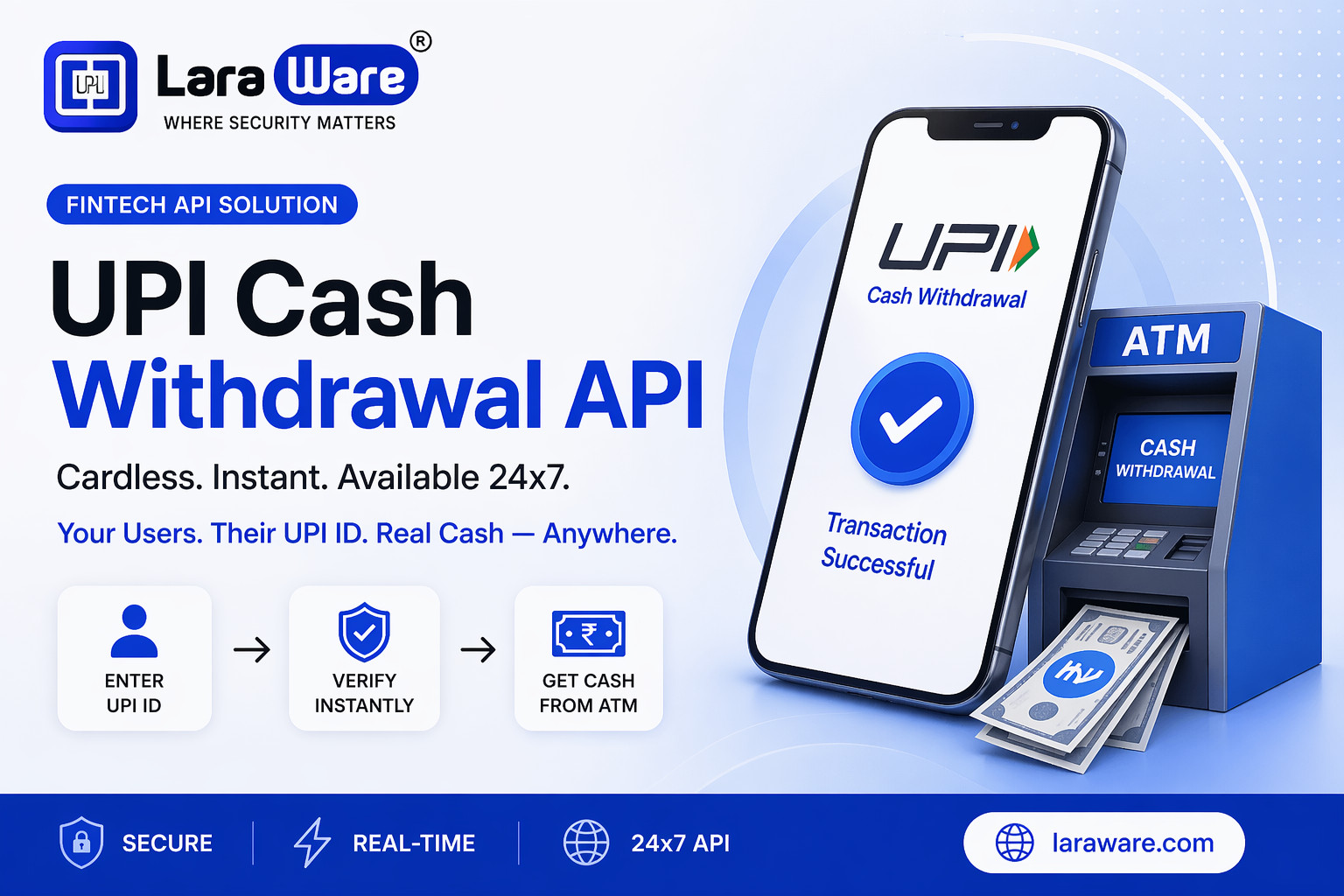
In practice, a UPI Cash Withdrawal API is a software integration that lets your platform send money to a user's UPI ID and simultaneously enable that user to collect the equivalent amount as physical cash from an authorized local agent or merchant.
On the user side, the journey stays lightweight: there is no card swipe, no bank queue, and no paperwork—people share a UPI ID, receive funds digitally, collect an OTP, walk to the nearest enrolled merchant, and pick up cash. Meanwhile, orchestration on the backend stays fully digital-first, automated, and auditable.
However, this is not a basic UPI transfer—it is a complete cash disbursement solution with OTP verification, merchant settlement, fraud checks, and full transaction logging built in.
How a UPI cash withdrawal API works (step by step)
- First, your platform sends a cash withdrawal request via the API with the user's UPI ID and amount.
- Next, funds are credited instantly to the user's UPI-linked account.
- Then, a one-time password (OTP) arrives on the user's registered mobile number.
- After that, the user walks to any enrolled nearby merchant or cash agent.
- At the counter, staff verify the UPI ID and OTP inside the merchant app.
- Finally, cash is handed over, the transaction is marked complete, and a full audit trail is saved.
In most cases, the entire flow wraps up in under three minutes. Because disbursement stays digital until the last mile, users avoid branch visits, heavy paperwork, and plastic cards altogether.
Who can use a UPI cash withdrawal API?
When your business sends money to users who may need it as cash, this API is for you. It is therefore particularly valuable for:
Lending Companies and NBFCs
Clearly, disburse approved loan amounts to borrowers in areas where ATMs are scarce. The borrower gets their money in minutes and can collect it as cash from a local merchant.
Fintech and Payment Apps
Similarly, add a cash access feature to your wallet or payment product. Users with digital balances can convert to cash at will — giving your app a reason to be used every day.
Government Payout Systems
Additionally, distribute subsidies, pensions, or welfare payments to beneficiaries who hold UPI IDs but may not have debit cards or live near a bank branch.
Payroll and HR Platforms
Likewise, pay daily wage workers, gig workers, or contractual staff digitally and let them withdraw their earnings in cash the same day from a local shop.
NGOs and Relief Organisations
Furthermore, transfer emergency funds to affected people instantly. Recipients can collect cash at nearest agents even when banking infrastructure is limited or disrupted.
Rural Banking Networks
Besides, extend your service reach without setting up physical ATM hardware. Enrol local merchants as cash agents and process withdrawals digitally through the API.
What Makes a Good UPI Cash Withdrawal API?
Admittedly, not all UPI APIs are built the same. When evaluating a provider, here are the things that actually matter for your business:
- No Card Required — Because withdrawals rely on only the UPI ID, you can skip plastic cards, PIN entry, and passbook proofs entirely.
- OTP Security — Since every cash handover is protected by a one-time password tied to the user's mobile number, no OTP means no cash.
- Real-Time Settlement — As a result, funds reach the UPI account instantly, with no waiting period between transfer and withdrawal eligibility.
- 24×7 Availability — Therefore, withdrawals can be initiated any time, including weekends and public holidays.
- Merchant Verification Layer — Specifically, enrolled merchants operate on a dedicated authenticated interface, preventing unauthorised cash payouts.
- Webhook Support — Thus, your server receives real-time status updates for every transaction — success, failure, or pending — without polling.
- Sandbox Testing — For instance, you can test every scenario before going live without touching real money or real users.
- Full Audit Logs — Hence, every event in the transaction lifecycle is logged with timestamp, device, and location data for compliance and dispute resolution.
The Real Problem This API Solves
Generally, India's payments infrastructure has a well-known last-mile gap. Although digital money reaches users fast, converting that money to cash still depends on ATM density, debit card penetration, and bank branch proximity. In large parts of India, all three are in short supply.
As a result, this creates a situation where:
- For example, a farmer may receive a government subsidy yet still struggle to withdraw when the nearest ATM runs dry.
- In another common case, a borrower sees a loan approved but holds no debit card on the credited account.
- Similarly, a daily wage worker might be paid digitally while the surrounding market insists on cash.
Consequently, a UPI Cash Withdrawal API does not wait for ATM infrastructure to catch up. It turns every enrolled kirana store, chemist, or general merchant into a cash access point — powered by your platform and secured by UPI.
Laraware · Fintech APIs
Indeed, this is not just a fintech feature. It is digital inclusion infrastructure — and Laraware can help you build it.
Naturally, you can contact Laraware at laraware.com to discuss your UPI Cash Withdrawal API integration. Let us build it together.
How Laraware Helps You Build This
Overall, at Laraware, we build software solutions for businesses that want to solve real problems at scale. Our UPI Cash Withdrawal API integration service covers everything your team needs to go from idea to live product:
- Firstly, API consultation — we help you identify the right UPI cash withdrawal provider and integration architecture for your specific use case.
- Secondly, end-to-end development — our team handles the full integration: API connection, webhook handling, OTP flow, merchant dashboard, and transaction reporting.
- Thirdly, Laravel and PHP expertise — if your platform runs on Laravel, we integrate natively. We also support Node.js, Python, and other stacks.
- Additionally, testing and QA — we validate every edge case in sandbox before any live deployment.
- Finally, ongoing support — post-launch maintenance, monitoring, and feature additions as your product scales.
In addition, we have worked with fintech startups, NBFCs, and payment platforms across India. As a result, we understand the compliance requirements, the settlement models, and the operational realities of building cash-access products for Indian users.
Three Scenarios Where This Changes Everything
Scenario 1 — The Village Borrower
In this scenario, Ravi lives in a village in Jharkhand. He gets a Rs. 12,000 personal loan approved through a fintech app. The nearest ATM is 18 km away and often out of cash. With UPI Cash Withdrawal, the money reaches his UPI ID instantly. He walks 200 metres to the local grocery store enrolled as a cash agent, shows his OTP, and collects the cash. Total time: four minutes.
Scenario 2 — The Government Beneficiary
Meanwhile, a state government scheme transfers Rs. 3,000 to 80,000 beneficiaries in a single batch. Each beneficiary gets an OTP. Over the next two days, all of them collect cash at their nearest village-level agent. Still, there are no branch queues and no debit card confusion. Full disbursement tracked and audited.
Scenario 3 — The Gig Worker
Similarly, a delivery platform pays its riders daily. Riders in smaller cities and towns can now convert their daily earnings to cash the same evening at enrolled local merchants. Hence, there is no more waiting two to three days for bank credits to show up.
UPI cash withdrawal API — quick FAQs
Do users need a debit card for this?
Simply put, no debit card is required. Only a UPI ID is needed. The user's UPI app and registered mobile number are sufficient.
Is this different from a normal UPI transfer?
Indeed, a standard UPI transfer moves money to a bank account. Conversely, this API creates a cash disbursement loop — the user receives digital money and can immediately collect the equivalent in physical cash at a verified merchant.
How secure is it?
Naturally, every transaction uses OTP verification, time-bound tokens, and encrypted API calls. Merchants are KYC-verified and operate on separate authenticated interfaces. No cash is released without a valid OTP match.
How long does integration take?
Typically, a basic integration takes two to four business days for an experienced developer. Full production deployment with testing usually takes seven to ten business days.
Can I white-label it under my brand?
Certainly, white-label options are available depending on the API provider. Speak to the Laraware team to understand what is possible for your specific product.
Closing Thoughts
India is building two parallel realities—one where digital payments are seamless and instant, and another where cash is still king for daily life. Therefore, the businesses that will win the next decade are the ones that bridge these two realities for their users.
A UPI Cash Withdrawal API is one of the most practical and impactful ways to do that. Specifically, it does not require you to build ATM hardware, nor does it force users to keep debit cards or bank branches nearby. Instead, it works through the UPI infrastructure India has already built and the merchant networks that already exist everywhere.
Lastly, if you want to add this capability to your platform, Laraware can help you build it the right way — cleanly, securely, and faster than you expect.
About Laraware
To sum up, Laraware is a technology company that builds fintech, e-commerce, and SaaS solutions for businesses across India. We are the parent company behind NXT Banking, FashionKart.ai, and several other digital platforms. Featured in Forbes India, Economic Times, and Hindustan Times. Visit laraware.com to explore what we build.