The fintech sector in India has experienced rapid growth over the past decade. With the rise of digital payments, online lending platforms, and investment apps, fintech companies are transforming how financial services are delivered. However, many investors still ask an important question: is fintech investment safe in India?

Understanding the risks, regulations, and opportunities in the fintech industry can help investors make informed decisions before investing in fintech startups or fintech-based financial services.


Growth of Fintech in India

India has become one of the fastest-growing fintech markets in the world. The increasing use of smartphones, digital banking, and online payments has created a strong environment for fintech innovation.

Key drivers of fintech growth include:

  • widespread adoption of digital payments

  • government initiatives supporting financial inclusion

  • rapid growth of e-commerce

  • increasing smartphone penetration

Many fintech platforms are developed by companies like Laraware, which build secure financial technology systems for businesses and startups.


Regulatory Framework for Fintech in India

One of the reasons fintech investment is becoming safer is the presence of strong regulatory oversight.

Financial services in India are regulated by authorities such as the Reserve Bank of India (RBI) and other financial regulators.

These regulations help ensure:

  • consumer protection

  • secure financial transactions

  • compliance with financial laws

  • monitoring of financial institutions

You can learn more about financial regulations on the official RBI website:
https://www.rbi.org.in


Advantages of Investing in Fintech

Investing in fintech companies can offer several benefits.

High Growth Potential

The fintech sector is expanding rapidly, creating strong growth opportunities for investors.

Innovation in Financial Services

Fintech startups are developing innovative solutions in digital payments, lending, wealth management, and insurance technology.

Financial Inclusion

Fintech platforms are helping millions of people access financial services for the first time.

Strong Digital Infrastructure

India’s digital payment infrastructure, managed by the National Payments Corporation of India (NPCI), supports secure and efficient transactions.

More information is available here:
https://www.npci.org.in


Risks of Fintech Investments

Although fintech investments offer strong opportunities, they also come with certain risks.

Regulatory Changes

Changes in financial regulations can impact fintech business models.

Market Competition

The fintech industry is highly competitive, with many startups entering the market.

Cybersecurity Threats

Financial platforms must protect sensitive data from cyber attacks.

Business Model Sustainability

Some fintech startups may struggle to build profitable business models.

Investors should carefully evaluate fintech companies before investing.


How to Evaluate Fintech Investments

Investors can reduce risks by analyzing several factors before investing.

Regulatory Compliance

Ensure the fintech company follows financial regulations.

Technology Infrastructure

Evaluate the platform’s security and scalability.

Business Model

Understand how the company generates revenue.

Market Demand

Assess whether the product solves a real financial problem.

Fintech companies that partner with technology providers like Laraware often benefit from strong technology infrastructure.


Future of Fintech Investment in India

The fintech industry is expected to continue growing as digital financial services expand.

Emerging technologies such as:

  • artificial intelligence

  • blockchain-based financial systems

  • embedded finance

  • digital banking

will further accelerate fintech innovation.

As the ecosystem matures and regulations strengthen, fintech investments are likely to become more secure and attractive.


Conclusion

So, is fintech investment safe in India? While fintech investments come with certain risks, the industry’s strong growth potential, regulatory oversight, and technological innovation make it an attractive sector for investors.

By carefully evaluating fintech companies and understanding the regulatory environment, investors can make informed decisions and benefit from the rapid expansion of financial technology in India.
case studies

See More Case Studies

ChatGPT Image May 7, 2026, 11_06_46 AM

Legal Rules for Money Transfer Business | DMT Compliance Guide India

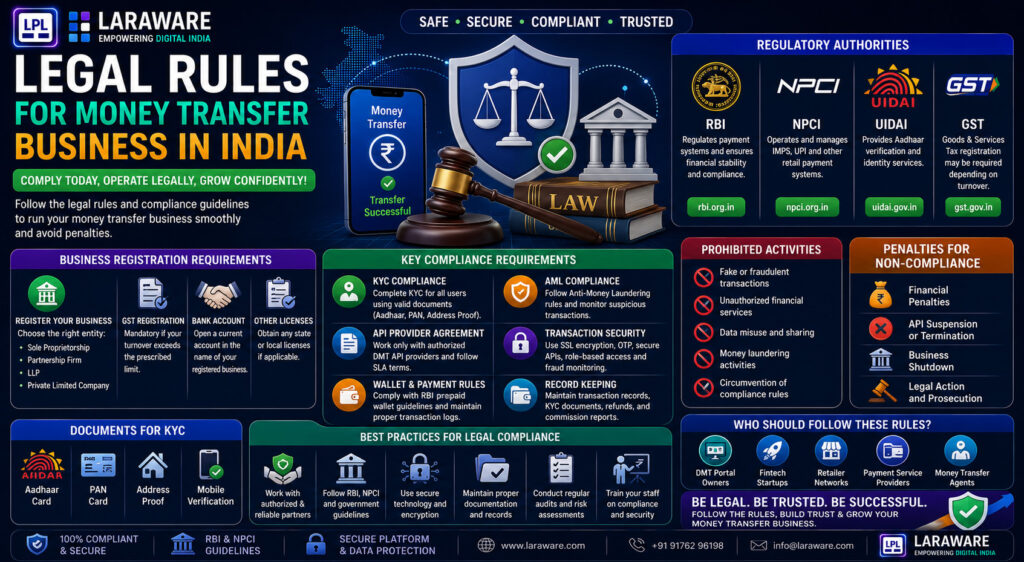
The money transfer business is a rapidly growing part of India’s fintech industry. However, because it involves financial transactions and customer data, businesses must follow strict legal and compliance requirements. Understanding the legal rules for a money transfer business is essential to avoid penalties, build customer trust, and ensure smooth operations. Is Money Transfer Business Legal in India? Yes, operating a money transfer business is legal in India when businesses comply with: RBI regulations KYC guidelines Financial transaction rules Data protection practices Money transfer businesses should work only with authorized banking and API partners. Important Regulatory Authorities Reserve Bank of India (RBI) RBI regulates digital payment systems and financial transaction practices in India. https://rbi.org.in/ National Payments Corporation of India (NPCI) NPCI manages IMPS, UPI, and payment infrastructure. https://www.npci.org.in/ UIDAI Handles Aadhaar verification and identity systems. Outbound link:https://uidai.gov.in/ Business Registration Requirements Register Your Business You can register as: Sole Proprietorship Partnership Firm LLP Private Limited Company GST Registration GST registration may be required depending on turnover and services offered. https://www.gst.gov.in/ KYC Compliance Rules KYC (Know Your Customer) verification is mandatory for money transfer businesses. Common KYC documents include: Aadhaar card PAN card Address proof KYC helps prevent fraud and money laundering. AML (Anti-Money Laundering) Compliance Businesses should monitor suspicious activities and maintain transaction records to comply with AML regulations. DMT API Provider Agreements Businesses should use only authorized and trusted DMT API providers. Important agreement areas: Transaction liability Commission structure Security policies Service-level agreements /how-to-choose-recharge-api-providers Transaction Security Requirements Money transfer portals should implement: SSL encryption OTP verification Secure APIs Role-based access Fraud monitoring /security-features-in-recharge-software Wallet and Payment Rules If your platform includes wallet services: Follow RBI prepaid wallet rules Maintain proper transaction logs Prevent unauthorized usage /how-wallet-systems-work-in-recharge-portals Data Protection Rules Businesses must protect: Customer data Transaction records Login credentials Important security measures include: Encrypted storage Secure servers Regular backups Record Keeping Requirements Maintain records for: Transactions KYC documents Refunds and reversals Commission reports Prohibited Activities Avoid: Fake transactions Unauthorized financial services Data misuse Fraudulent wallet operations Penalties for Non-Compliance Non-compliance can result in: Financial penalties API suspension Business shutdown Legal action Best Practices for Legal Compliance Work with authorized API providers Follow RBI and NPCI guidelines Use secure technology Maintain proper documentation Conduct regular audits Who Should Follow These Rules? DMT portal owners Fintech startups Retailer networks Payment service providers Money transfer agents Future Compliance Trends Future regulations may include: Stronger digital KYC systems AI-based fraud monitoring Enhanced data protection laws Advanced transaction tracking Conclusion The money transfer business in India offers excellent growth opportunities, but businesses must operate within legal and regulatory frameworks. Following RBI guidelines, KYC norms, security practices, and proper documentation is essential for long-term success. A legally compliant money transfer business builds trust, prevents fraud, and ensures sustainable growth in the fintech industry. Share this:LinkedInTwitterFacebookWhatsAppEmail

Learn more
ChatGPT Image May 7, 2026, 10_57_38 AM

DMT Commission Structure Explained | Money Transfer Earnings Guide

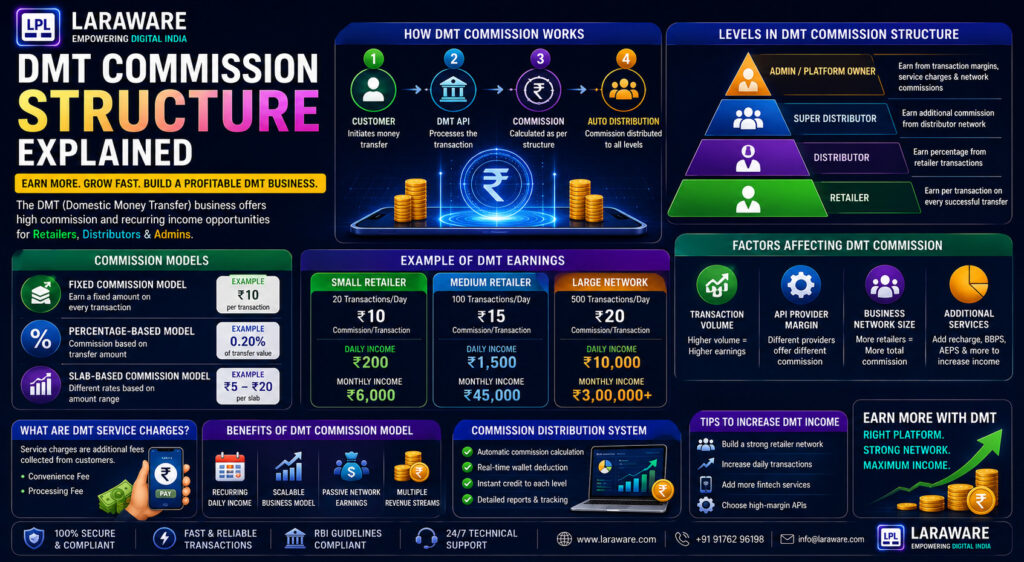
The DMT (Domestic Money Transfer) business is one of the most profitable fintech services in India because it offers recurring commission-based earnings. Understanding the DMT commission structure is important for retailers, distributors, and fintech platform owners who want to maximize profits from money transfer services. What is DMT Commission? DMT commission is the amount earned on every successful money transfer transaction. Commission is generally distributed among: Retailers Distributors Super distributors Admin or platform owner /what-is-dmt How DMT Commission Structure Works When a customer transfers money through a DMT portal: The customer pays transfer amount + service charge The transaction is processed through DMT API Commission is distributed automatically Levels in DMT Commission Structure Retailer Commission Retailers directly serve customers and earn commission per transaction. Typical retailer earnings: ₹5 – ₹25 per transaction Distributor Commission Distributors manage retailer networks and earn a percentage from retailer transactions. Super Distributor Commission Large networks may include super distributors who receive additional commission. Admin Earnings Platform owners earn from: Transaction margins Service charges Network commissions /how-recharge-software-makes-money Types of DMT Commission Models Fixed Commission Model A fixed amount is earned on every transaction. Example: ₹10 per successful transfer Percentage-Based Commission Commission is calculated based on transfer amount. Example: 0.2% of transfer value Slab-Based Commission Different commission rates based on transaction range. Example: Amount Range Commission ₹1 – ₹1000 ₹5 ₹1001 – ₹5000 ₹10 ₹5001 – ₹10000 ₹20 Example of DMT Earnings Small Retailer 20 transactions/day ₹10 commission per transaction Daily income = ₹200 Monthly income ≈ ₹6000 Medium Retailer 100 transactions/day ₹15 commission Daily income = ₹1500 Monthly income ≈ ₹45,000 Large Network Distributor networks can generate lakhs in monthly commission. Factors Affecting DMT Commission Transaction Volume Higher volume = higher earnings API Provider Margin Different providers offer different commission structures. /how-to-choose-recharge-api-providers Business Network Size More retailers increase total commission income. Additional Services Businesses offering recharge, BBPS, and AEPS earn extra revenue. /services-available-in-a-bbps-portal DMT Service Charges Some platforms charge customers additional service fees. Examples: Convenience fee Processing fee These increase platform profitability. Commission Distribution System Modern DMT portals automatically: Calculate commissions Deduct wallet balance Credit earnings Generate reports /how-wallet-systems-work-in-recharge-portals Benefits of DMT Commission Model Recurring daily income Scalable business model Passive network earnings Multiple revenue streams Common Challenges Low margins in competitive markets Failed transaction disputes Wallet balance mismatch Delayed settlements /common-problems-in-recharge-portals How to Increase DMT Income Build Retailer Network Expand your distributor network. Increase Daily Transactions Offer fast and reliable service. Add More Fintech Services Integrate recharge, BBPS, insurance, and AEPS. Choose High-Margin APIs Select providers with better commission structures. Future of DMT Earnings in India DMT commissions are expected to grow due to: Increased digital payment adoption Expansion in rural markets Fintech growth in India https://www.npci.org.in/https://rbi.org.in/ Conclusion The DMT commission structure is the foundation of the money transfer business model. Whether you are a retailer, distributor, or platform owner, understanding commission flow helps maximize profitability. With the right API provider, strong network, and efficient platform, DMT services can generate stable and scalable income for fintech businesses. Share this:LinkedInTwitterFacebookWhatsAppEmail

Learn more
ChatGPT Image May 7, 2026, 10_29_54 AM

Money Transfer Portal Development | DMT Portal Development India

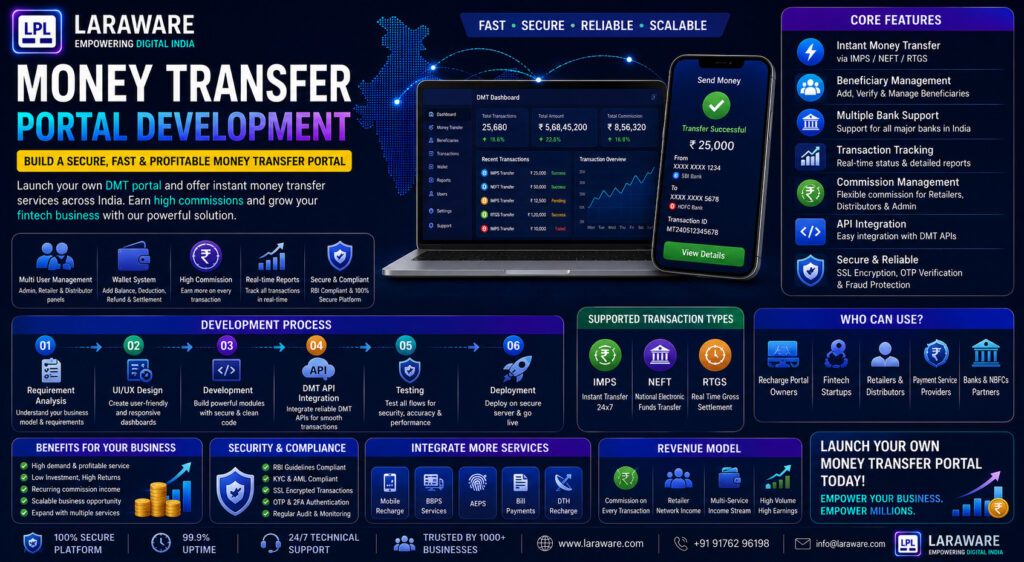
Money transfer portal development is a strong opportunity in India’s fintech market. A money transfer portal allows users, retailers, and distributors to send money securely from one bank account to another using digital systems. With growing demand for DMT services, fintech businesses can build scalable platforms and earn commission on every successful transaction. What is a Money Transfer Portal? A money transfer portal is a digital platform that enables domestic fund transfers through services like: IMPS NEFT RTGS DMT API /what-is-a-dmt-api Key Features of Money Transfer Portal User Registration and KYC Allows users to register and complete identity verification. Beneficiary Management Users can add, verify, and manage receiver bank details. Money Transfer Module Supports secure fund transfers across major banks. Wallet System Manages retailer balance, deductions, refunds, and commissions. /how-wallet-systems-work-in-recharge-portals Transaction Reports Tracks successful, failed, pending, and reversed transactions. Admin and Retailer Panel Helps manage users, transactions, commissions, and support. Money Transfer Portal Development Process Step 1: Business Planning Define target users, business model, services, and revenue structure. Step 2: Choose Technology Stack Use secure and scalable technologies for frontend, backend, database, and hosting. Step 3: Design Dashboard Create a clean dashboard for admin, retailer, distributor, and customer use. Step 4: Develop Backend System Build wallet, commission, user management, transaction, and reporting modules. Step 5: Integrate DMT API Connect with a reliable DMT API provider for secure money transfer processing. /dmt-api-integration-guide Step 6: Add Security Features Include SSL, OTP, token authentication, role-based access, and audit logs. /security-features-in-recharge-software Step 7: Testing and Deployment Test all transaction flows, then deploy on a secure server. Cost of Money Transfer Portal Development Basic Portal ₹50,000 – ₹1,50,000 Standard Portal ₹1.5L – ₹5L Advanced Portal ₹5L – ₹20L+ Benefits of Money Transfer Portal High demand service Recurring commission income Scalable retailer network Works in rural and urban markets Can integrate recharge, BBPS, and AEPS services Challenges in Development API downtime Failed transactions Wallet mismatch Compliance requirements Security risks /common-problems-in-recharge-portals Legal and Compliance Requirements Money transfer portals should follow RBI guidelines, KYC norms, secure transaction practices, and authorized API agreements. https://www.npci.org.in/https://rbi.org.in/https://uidai.gov.in/ Conclusion Money transfer portal development is a profitable fintech opportunity for businesses that want to offer fast and secure DMT services. With proper planning, reliable API integration, strong wallet management, and security features, you can build a scalable platform. A well-developed money transfer portal can generate steady income while helping users access convenient financial services. Share this:LinkedInTwitterFacebookWhatsAppEmail

Learn more
Contact us

Partner with Us for Comprehensive IT Solutions

We’re happy to answer any questions you may have and help you determine which of our services best fit your needs.

Your benefits:
What happens next?
1

We Schedule a call at your convenience 

2

We do a discovery and consulting meting 

3

We prepare a proposal 

Schedule a Free Consultation